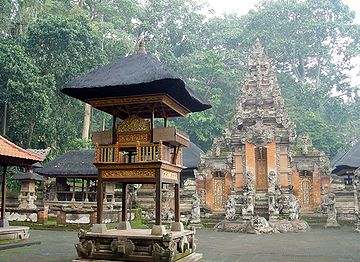
Richly adorned Kori Agung gate and pavilions within Pura Dalem Agung Padantegal compounds in
Bali.
A
Pura is a
Balinese Hindu temple.
[1] and the place of worship for the adherents of
Balinese Hinduism in
Indonesia. Puras are built in accordance to rules, style, guidance and rituals found in
Balinese architecture. Most of the puras are found on the island of
Bali, as Hinduism is the predominant religion in the island; however many puras exist in other parts of Indonesia where there are significant numbers of
Balinese people.
Mother Temple of Besakih is the most important, the largest and holiest temple in Bali.
[2] A large number of puras have been built in Bali, leading it to be titled "the Island of a Thousand Puras".
Etymology[edit]

The
pagoda-like tiered roofs tower of Pelinggih Meru is the distinctive feature of Balinese temple.
The term
pura originates from the
Sanskrit word (
-pur, -puri, -pura, -puram, -pore), meaning "city", "walled city", "towered city", or "palace". During the development of the
Balinese language the term
pura came to refer to a religious temple complex, while the term
puri came to refer to
palace, the residence of kings and nobles, similar to
Javanese kratons.
Design and layout[edit]
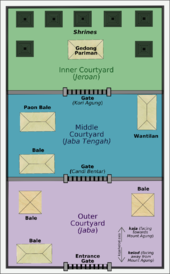
Balinese temple layout, arranged in three zones (
mandalas)
Unlike the common towering indoor
Indian Hindu temple, puras are designed as an open air place of worship within enclosed walls, connected with a series of intricately decorated gates between its compounds. This walled compounds contains several shrines,
meru (towers), and
bale (pavilions). The design, plan and layout of the pura follows the
trimandala concept of Balinese space allocation.
[3] Three
mandala zones arranged according to a sacred hierarchy:
- Nista mandala (jaba pisan): the outer zone, which directly connects the pura compound with the outer realm, and the entrance to the temple. This zone usually takes the form of an open field or a garden that can be used for religious dance performances, or act as an additional space for preparations during religious festivals.
- Madya mandala (jaba tengah): the middle zone of the temple, where the activity of adherents takes place, and also the location for supporting facilities of the temple. In this zone usually several pavilions are built, such as the bale kulkul (wooden Slit drum tower), bale gong (gamelan pavilion), wantilan (meeting pavilion), bale pesandekan, and bale perantenan, the temple's kitchen.
- Utama mandala (jero): the holiest and the most sacred zone within the pura. This enclosed and typically highest of the compounds usually contains a padmasana, the towering lotusthrone of the highest god, Acintya (the Sang Hyang Widhi Wasa, or “All-in-one God”, in modern Balinese), the pelinggih meru (a multiple roofed tower, similar in design to the Chinese orJapanese pagoda), and several pavilions, such as bale pawedan (vedic chanting pavilion), bale piyasan, bale pepelik (offering pavilion), bale panggungan, bale murda, and gedong penyimpenan (storehouse of the temple's relics).
However, the layout rules for arrangements the facilities of the two outer zones, nista mandala and madya mandala, are somewhat flexible. Several structures, such as the bale kulkul, could be built as outer corner tower; also, the perantenan (temple's kitchen) could be located in the Nista mandala.

Stairs and terraces leading to the
candi bentar split gate of
Pura Besakih.

Towering
kori agung gate at Pura Taman Saraswati
Ubud.
There are two types of gates within
Balinese architecture: the split gate, known as
candi bentar,
[4] and the roofed tower gate in
Paduraksa style, usually called
kori agung. Both types of gates have specific roles in Balinese architectural design. Candi bentar is the gate used in the nista mandala, while the kori agung is employed as the gate between the madya mandala and Utama mandala inner compounds. The rules for gate types are also valid for non-religious compounds such as puri, nobles' and kings' residences.
Types of pura[edit]
There are several types of pura, each serving certain functions of Balinese rituals throughout the
Balinese calendar. The Balinese temples are arranged according to the physical and spiritual realm of Balinese people, which corresponds to
kaja-kelod sacred axis, from mountain tops the realms of gods,
hyang spirits, the middle fertile plain the realm of humans, all the way to the beach and ocean, the realm of sea deities and demons.
- Pura kahyangan jagad: pura that are located in the mountainous region of the island, built upon mountain or volcano slopes. The mountains are considered as the sacred realm, the abode of gods or hyang. The most important pura kahyangan in Bali is Mother Temple of Besakih complex on the slopes of Mount Agung.
- Pura tirta: "water temples", a type of pura that other than religious function, also have water management function as part of Subak irrigation system. The priests in these temples have authority to manage the water allocation among rice paddies in the villages surrounds the temple. Some tirta temples are noted for its sacred water and having petirtaan or sacred bathing pool for cleansing ritual. Other water temple are built within lakes, such as Pura Ulun Danu Bratan. The example of this type of temple are Pura Taman Ayun and Pura Tirta Empul.
- Pura desa: a type of pura dedicated to the worship of Brahma, that are located within villages or cities, serving as the center of Balinese people's religious activities.
- Pura puseh: a type of pura dedicated to the worship of Vishnu.
- Pura dalem: a type of pura dedicated to the worship of Shiva. Usually Shiva's shakti, Durga, is venerated in this temple. In human life cycle, the temple is connected to rituals concerning death.
- Pura mrajapati: a type of pura to worship prajapati (the lord of people) or the cosmic might. Most often, in this temple Shiva is worshipped in his form as prajapati. Often describes as the temple of the dead, this type of temple often functioned as the graveyard of the deceased prior to ngaben (cremation) ceremony.
- Pura segara: pura that are located by the sea to appease the sea deities. It is usually important during the Melasti ritual. The example of this type of temple is Pura Tanah Lot and Pura Uluwatu.
Sad Kahyangan[edit]
The
Sad Kahyangan,
Sad Kahyangan Jagad or the "six sanctuaries of the world" are the six holiest places of worship on Bali.
[5] According to Balinese beliefs, they are the pivotal points of the island, and are meant to provide spiritual balance to Bali. The number of these most sacred sanctuaries always adds up six, but depending on the region, the specific temples that are listed may vary.
[6] A list of the Sad Kahyangan may include:
Sea Temples[edit]
Bali has a number of important "sea temples" (Balinese:
pura segara) which were founded in the 16th-century by a
Majapahit Brahmin from
Java named
Nirartha to honour the gods of the sea.
[7] Each of the temples is traditionally said to be visible from the next, forming a 'chain' around the coast of Bali. Many of the most important sea temples are located along the south-west coast of the island. The temples' positions was meant to provides a chain of spiritual protection for the Bali island.
Listed counterclockwise from Nirartha's legendary point of arrival in Bali, some of the most prominent Balinese sea temples include:
- Pura Pulaki near Pemuteran, northeast of Gilimanuk (
 8°8′44″S 114°40′50″E).
- Pura Gede Perancak, to the south of Negara (8°24′5″S 114°36′40″E).
- Pura Rambut Siwi, to the east of Negara (8°24′11″S 114°45′59″E)
At this site Nirartha is said[by whom?] to have made a gift of a lock of his hair, which was worshipped. Rambut Siwi translates as 'worship of the hair'[8] and the tale is reminiscent of the Buddhist story of Gautama giving eight hairs to Tapussa and Bhallika, which are now enshrined at Shwedagon.
- Pura Tanah Lot, west of Canggu and south of Tabanan city where two puras were built on a coastal rock overlooking the Indian Ocean as the shrine to honor sea deities. (8°37′16″S 115°5′12″E).
- Pura Luhur Uluwatu, at the southwestern extremity of the Bukit Peninsula (8°49′44″S 115°5′7″E). This is the only Balinese sea temple that is also one of the six Balinese directional temples.
- Pura Mas Suka, at the southern tip of the Bukit Peninsula, near Greenbowl Beach (8°50′52″S 115°10′11″E).
- Pura Sakenan on Serangan island, an island between Tanjung Benoa and Sanur (8°43′31″S 115°13′47″E).


