The
Asian palm civet (
Paradoxurus hermaphroditus), also called
toddy cat, is a small member of the family
Viverridae native to
South and
Southeast Asia. In 2008, the
IUCN classified the species as
Least Concern as it is tolerant of a broad range of
habitats. It is widely distributed with large populations that in 2008 were thought unlikely to be declining.
[2] In 2012, it was suggested that recent increases in capturing the animals for
Kopi Luwak production may constitute a significant threat to wild civet populations.
[3]
Characteristics[edit]
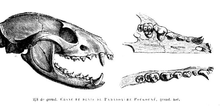
Illustration of skull and dentition, by
Gervais in
Histoire naturelle des mammifères

Close up of Asian palm civet
The Asian palm civet is a small, mottled gray and black
viverrid weighing 2 to 5 kg (4.4 to 11.0 lb). It has a body length of about 53 cm (21 in) with a 48 cm (19 in) long tail. Its long, stocky body is covered with coarse, shaggy hair that is usually greyish in color. There is a white mask across the forehead, a small white patch under each eye, a white spot on each side of the nostrils, and a narrow dark line between the eyes. The muzzle, ears, lower legs, and distal half of the tail are black, with three rows of black markings on the body. The tail is without rings, unlike in similar
civet species. Anal
scent glands emit a
nauseating secretion as a
chemical defense when threatened or upset.
[4] Despite its species name
hermaphroditus, the civets (like all other mammals) have two distinct sexes and are not
hermaphrodites.
Distribution and habitat[edit]
Asian palm civets are native to
India,
Nepal,
Bangladesh,
Bhutan,
Myanmar,
Sri Lanka,
Thailand,
Singapore,
Peninsular Malaysia,
Sabah,
Sarawak,
Brunei Darussalam,
Laos,
Cambodia,
Vietnam,
China,
Philippines and the
Indonesian islands of
Sumatra,
Java,
Kalimantan,
Bawean and
Siberut. They were introduced to
Irian Jaya, the
Lesser Sunda Islands,
Maluku,
Sulawesi and
Japan. In
Papua New Guinea, their presence is uncertain.
[2]
They normally inhabit
primary forests, but also occur at lower densities in secondary and selectively logged forest.
[5]
They also inhabit parks and suburban
gardens with mature fruit trees,
fig trees and undisturbed vegetation. Their sharp claws allow them to climb trees and house gutters. In most parts of Sri Lanka, palm civets are considered a nuisance since they litter in ceilings and attics of common households, and make loud noises fighting and moving about at night.
Ecology and behaviour[edit]

Asian palm civet juvenile
Asian palm civets are believed to lead a
solitary lifestyle, except for brief periods during
mating. They are both terrestrial and arboreal, showing
nocturnal activity patterns with peaks between late evening until after midnight.
[5] They are usually active between 6:00 pm and 4:00 am, being less active during nights when the moon is brightest.
[6]
Scent marking behaviour and
olfactory response to various excretions (such as urine, feces, and secretion of the
perineal gland) differs in males and females. Scent marking by dragging the perineal gland and leaving the secretion on the substrate was most commonly observed in animals of both sexes. The olfactory response varied by duration, and depended both on the sex and excretion type. The palm civet can distinguish animal species, sex, and familiar/unfamiliar individuals by the odor of the perineal gland secretion.
[7]
Feeding and diet[edit]
Reproduction[edit]
Due to their solitary and nocturnal habits, little is known about the reproductive processes and behaviour of civets.
[9] In March 2010, a pair of palm civets was observed when attempting to mate. The pair copulated on the tree branch for about five minutes. During that period the male mounted the female 4–5 times. After each mounting the pair separated for few moments and repeated the same procedure. After completion of mating, the pair frolicked around for some time, moving from branch to branch on the tree. The animals separated after about six minutes and moved off to different branches and rested there.
[10]
Threats[edit]
Hunting[edit]
In some parts of its range Asian palm civets are hunted for
bush meat and the pet trade. In southern China it is extensively hunted and trapped. Dead individuals were found with local tribes in
Coimbatore,
Tamil Nadu and
Agra,
Uttar Pradesh in India between 1998 and 2003, where it is killed for its meat.
[2] The oil extracted from small pieces of the meat kept in
linseed oil in a closed earthen pot and regularly sunned is used indigenously as a cure for
scabies.
[11]
Kopi Luwak[edit]
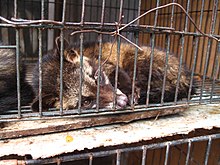
Civet housed in a cage for the production of Kopi Luwak coffee
Kopi Luwak is traditionally made from the faeces of wild civets, however, due to it becoming a trendy drink, civets are being increasingly captured from the wild and fed
coffee beans to mass-produce this blend. Many of these civets are housed in
battery cage systems which have been criticised on animal welfare grounds.
[14][15] The impact of the demand for this fashionable coffee on wild civet populations is yet unknown but may constitute a significant threat. In Indonesia, the demand for Asian palm civets appears to be in violation of the quota set for pets.
[